
Exchange rates are one of the most important and least discussed drivers of malt prices. Most internationally traded malt is priced in US dollars, and less often in euros, but it is produced with local-currency barley, energy and labour. When an exporter's currency weakens against the dollar, its malt becomes cheaper in dollar terms, even if nothing else has changed. For buyers comparing origins, the past year's currency moves are large enough to matter.
Why currencies matter for malt
A maltster's costs are almost entirely domestic: barley, gas and electricity, wages, and inland freight. Its revenue on export sales is usually in dollars. If the local currency depreciates, each dollar earned covers more of those costs, which gives the exporter room to offer a lower dollar price.
Importers face the reverse. A brewery in Southeast Asia, Latin America or Africa buys malt in dollars but sells beer in its own currency. When its currency weakens, imported malt becomes more expensive to it, whatever happens to the dollar price.
Two sets of exchange rates therefore affect every malt trade: the exporter's currency against the dollar, and the dollar against the importer's currency.
The currencies to watch
On the export side, the main currencies are the euro, Australian dollar, Ukrainian hryvnia and Chinese yuan. The Canadian dollar and Argentine peso matter to a lesser extent. All else being equal, a weaker currency points to cheaper malt from that origin in dollar terms. A stronger one points to dearer malt.
What the past year shows
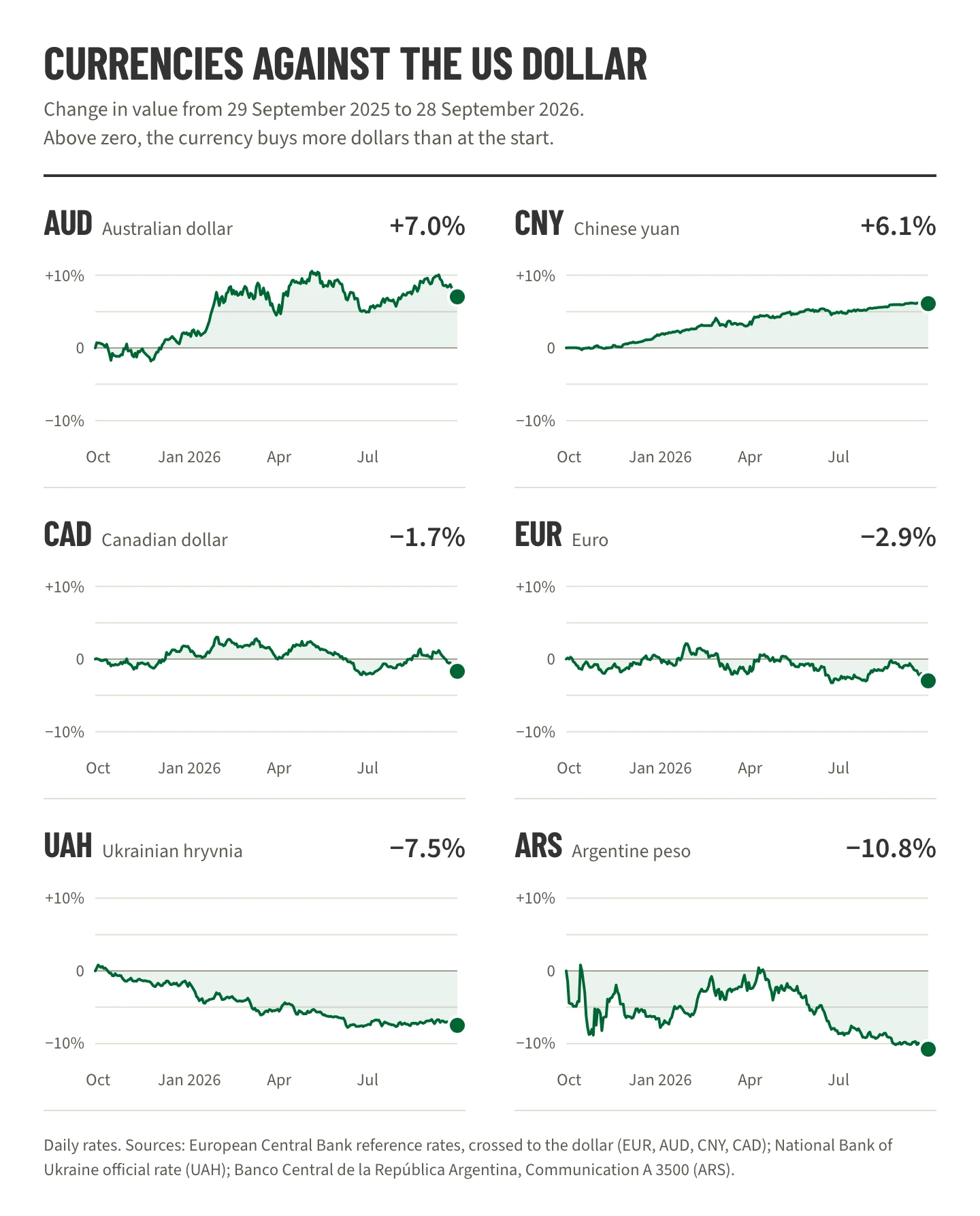
- Australian dollar (+7.0%). Most of the gain came in January and February. The currency peaked at around 10% above its starting level in the spring and has fluctuated since. On currency alone, Australian malt is noticeably dearer in dollar terms than a year ago.
- Chinese yuan (+6.1%). The yuan rose slowly and steadily all year, which is typical of a closely managed currency. Chinese malt has lost some price competitiveness as a result.
- Canadian dollar (−1.7%). Broadly flat for most of the year, with a dip in recent weeks. Canadian countertariffs took effect on 8 September, which adds trade-policy risk to the outlook.
- Euro (−2.9%). The euro traded close to its starting level for most of the year before weakening in September as the dollar rallied. European malt is slightly cheaper in dollar terms.
- Ukrainian hryvnia (−7.5%). A steady, managed depreciation all year. Together with the domestic discount on Ukrainian barley described in our harvest report, this makes Ukrainian malt particularly competitive on price.
- Argentine peso (−10.8%). The most volatile currency in the group. It swung sharply in autumn 2025, recovered in the spring and has fallen steadily since May.
In short, over the past year the exchange-rate effect has favoured Ukrainian, Argentine and European origins over Australian and Chinese.
US trade policy and the dollar
The Trump administration's trade policy has been a major source of currency volatility. Its stated aim is to reduce US trade deficits and rebuild domestic industry. A weaker dollar would support both goals, because it makes US exports cheaper and imports dearer. This has put persistent political pressure on the dollar.
The legal basis for tariffs has also shifted during the year. The broad IEEPA tariffs were struck down by the Supreme Court on 20 February 2026, and a replacement 10% tariff on nearly all trading partners was in effect from 24 February through 24 July 2026. Country-specific measures remain in place. Each change has moved currency markets.
Recently, however, other forces have outweighed that political pressure. The Federal Reserve raised rates to 3.75–4.00% and projects no cuts in 2027. The dollar index rose from 98.61 on 9 September to 100.98 on 25 September, a gain of 2.4% in just over two weeks. High oil prices and strong US economic data have added to inflation concerns and to expectations of further Fed tightening.
Bond markets and interest rates
Interest rates, as reflected in bond yields, are closely linked to exchange rates. Standard theory holds that the gap in interest rates between two countries should be offset by an expected fall in the higher-yielding currency. In practice, higher rates often strengthen a currency in the short term, because they draw in capital looking for better returns.
This is a particularly volatile period for bond markets. On 24 September the 10-year US Treasury yield reached its highest level since June 2007, and the 30-year yield touched levels not seen since 2004. Yields elsewhere have also risen, amid concern about government debt and persistent inflation. Higher borrowing costs affect the malt trade directly, through the cost of financing inventory and working capital, and indirectly, through their effect on currencies.
Conclusions
- Currency moves over the past year have made Ukrainian, Argentine and, to a lesser degree, European malt more competitive in dollar terms. Australian and Chinese malt have become dearer.
- The dollar's direction is uncertain. Trade policy favours a weaker dollar, while higher US interest rates and inflation concerns are currently strengthening it.
- For buyers, comparing origins on the same currency basis, and monitoring their own currency against the dollar, is as important as tracking barley prices.